Puerto Rico Deluxe Ed
Awaken Realms crowdfunded Puerto Rico Special Edition in Sep 2024. The campaign was open for 21 days only. It raised $5.710 mil from 23,356 backers. It was finally shipped out starting from last month.
Good thing I didn't know about it then, or I would have been seriously tempted. The game is fully pimp'ed out. The Grande version, which has everything, costs US$279 before shipping. If you just want the game of PR, it is slightly cheaper to get the Landscape version (US$195) + US$43 for Acrylic tiles.
I'm not sure I want to spend so much on PR, though.
Cost breakdown:
- Standard: US$59
- Special: US95 (Deluxe components: figure miniatures, resource crates, cargo ship miniatures, metal coins)
- Playmat: +US$15
- Acrylic tiles: +US$43
- 3D terrain pack: +US$95
- Artbook: +US$15
The most bang-for-buck is Special + playmat for US$110. This is sufficient for playing. The rest is bling.
I searched how normal edition looks like now, and found there has been some changes since 2018 when I last looked. Sidenote: it is now ranked #54 on BGG.
Rio Grande Games (RGG) finally released a new edition with updated art in 2019 — 8 years overdue. This is so ironic, since I went to "some lengths" to get the HK bilingual Chinese/English Classic edition just one year before.
RGG must have lost its license (almost 20 years, a good run), because Alea/Ravensburger released a new version with new art in 2020. A HK bilingual Chinese/English Deluxe edition was published in 2021.

波多黎各 豪華版 (2021)
Should I buy it?
This release was short-lived. Alex released Puerto Rico 1897 in 2022 to appease criticisms of the original theme — it was peak Woke in early 2020s. It has new art.
If you are not offended by certain wordings, just get earlier editions. Puerto Rico is just a backdrop to an economic engine game. Don't think too much.
EWEADN (前行者) V82 keyboard
My notebook's 'T' key is spoilt, so I brought out my old Logitech K270 full-size keyboard to use. It works well, but it does not have backlit keys — which is useful in the dark.
After much procrastination and some searching, I got myself a fancy RGB keyboard. I have three considerations:
- Pressed keys to light up, otherwise off
- Frosted key caps
- Bluetooth
Most sellers just show off one dazzling lighting effect — the one they feel is most impressive. They don't bother to go through each and every effect. I had a hard time finding a keyboard that can do this — I feel most keyboards can do it, but I don't want to take the risk.
Frosted looks better than transparent — the whole key lights up uniformly.
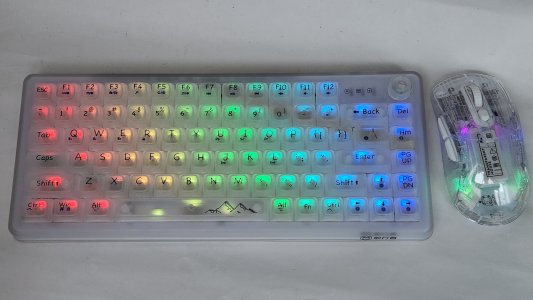
EWEADN V82 and Q8
This is a 75% Compact model with 82 keys. There is a bigger V99 Pro (96% Compact) model with numpad (98 keys) which makes it more versatile, but I decided to go with the smaller size.
Bluetooth (3 modes, actually), mechanical, swappable key switches and key caps, 3000 mAh battery.
Battery lasts around a week on full charge. Coming from K270 where a pair of AA batteries last over a year, this is extremely quick. Maybe it'll last longer if I switch it off after use?
It comes with OEM key caps, which are a bit too high for me. I've never made so many typing mistakes in my life! I'm used to low profile keys (either notebook or K270).
I'll give Cherry key caps a try. While not low-profile, they are a good 2 mm shorter (9.4 mm vs 11.9 mm). I need something like DSA (7.6 mm) — I can't seem to find them, though.
The keys make a thock sound... which sounds like you are walking on pebbles? Nice, but it is rather loud.
There are 18 color effects mode, but only 4 react to key presses. The only one I like is where the key lights up when pressed. This color effect is not good for entering password!
There is an opposite effect where every key is lighted and turns off when pressed. However, it turns back on too quickly.
It turns out I still can't see the keys in the dark, because I turn the light off by default. I wish there is a key that when you press it, say Left Shift, will light up every key.
The Backspace (especially) and Enter keys have tendency to get stuck, leading to auto-repeat.
I was somewhat worried if the shortened Right Shift would give me trouble, but it turned out I tend to press on the left side of it, so it was fine.
The rightmost column of keys are: Del, Home, PgUp, PgDn. I wish it is the more useful Home, PgUp, PgDn, End like my notebook. I keep pressing PgUp when I want to PgDn. If I map the keys to be like my notebook, it will be missing Del.
There is no dedicated keys for Insert and End. You need to press Fn+J and Fn+L. I prefer End to be Fn+Home.
On the mouse
A RGB keyboard needs a RGB mouse, so I got the Q8 mouse. It is Bluetooth and has 8 lighting effects.
I immediately found that I could not use it — it was too big for me. I have always used small mice. I had not realize I only use my fingers to move the mouse, my hand never moves. The Q8 mouse is too long and touches my palm, so I have to move my whole arm. I could not use it.
My current mouse is the Logitech M325S. I have been considering using Bluetooth to eliminate the 2.4 GHz USB receiver. Am planning to switch over to the Logitech M240 mouse. It does not feel as nice as M325S, though.
SS86 Thundercracker
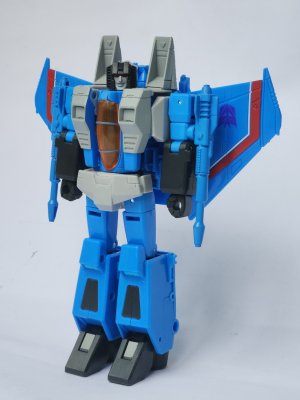
SS86 Thundercracker
I saw this in TRU. S$62.99, full price. I decided to buy it. Don't want to wait and worry about it being sold out.
It looks so clean!
It is not without flaws, though, being a mainline figure. He needs gap fillers (89 yuan; S$16.30). Posed hands (75 yuan; S$13.70) and facial expressions (49 yuan; S$9) are also available.
Skywrap is coming out in wave 2. I most likely won't be getting it. I'm not a seeker completionist.
Starscream is a Target exclusive. Don't know if it will be available for rest of the world. I usually get SS for seeker mold, because it is out first and is the most recognizable. It is a nice change to get someone else.
It helps that this TC has the lighter blue that I like. Different iterations are sometimes in darker blue (like his original G1 toy) or lighter blue (like in the original '84 cartoon).
I may get one Conehead if they are done well — again, only one out of three, even though they are slightly different and not pure repaints like the original three seekers.
Red Beauty mandarin oranges

红美人
Isn't there supposed to be at least 8 per case? Mine only has seven — there are six here cos I've eaten one.
Lesson for 2026: always check!
Seedless – yes. Sweet – so-so. Easy to peel – depends where you start, but mandarin oranges are supposed to be easy to peel.
Comparing Philips last-gen air purifiers
||AC2936|AC3033|AC4231|
|---|---|---|---|
|CADR (m^3/h)|380|520|610|
|Room sz (m^2)|98|135|158|
|Speeds|3 (S, 1, T)|4 (S, 1, 2, T)|4 (S, 1, 2, T)|
|Max power (W)|46|55|60|
|Sound (dB)|15 - 54|15 - 56|30 - 70|
|Height|58.5 cm|64.5 cm|70.5 cm|
|Width|27.4 cm|29 cm|30.6 cm|
|Weight|5.8 kg|6.8 kg|8.9 kg|
|Filter|FY2180/30|FY3430/30|FY4440/30|
AC4231 lists CADR by fan speed:
- Sleep: 70 m^3/h, 30 dB
- Speed 1: 180 m^3/h, 38 dB
- Speed 2: 300 m^3/h, 49 dB
- Turbo: 610 m^3/h, 70 dB
This illustrates nicely that (i) the real CADR is really half, unless you can bear the super-noisy Turbo mode, (ii) you need a big unit for a small room if you want it to be silent.
Rule of thumb: max 50 dB in living room and 30 dB in bedroom.
Is the AC3033 really 56 dB (@ 1.5 m) in Turbo mode? It sounds awfully loud. I used an app to measure. It is 60 dB at 3 m away! It is 70 dB beside the unit — it is very loud. The good news is Speed 2 is <50 dB at 2 m, the noise is acceptable.
Being green on Technology Connections
Of all renewable energy, solar has the least impact on the environment. But it is still not cost competitive without subsidies. If we want to be self-reliant on solar power, we also need battery storage large enough for night time.
It is often assumed once up, solar farms can run unattended — maintenance aside — for decades. Except on this timescale, we need to take into account catastrophic weather. Solar panels are fragile.
But it is the last part of the video that he got unhinged about events that had occurred in Minneapolis.
This is the outcome when rot has embedded so deeply. You need force to extract it. It will be painful. It will be ugly.
I'm not sure which part of illegal immigrant he — and others — does not understand. I L L E G A L.
Investigating people who may have committed fraud. F R A U D.
While I'm at it, I might as well say it: only citizens can vote. This is already supposed to be true, but you can't tell unless you check, can you?
The search for pure air
Six years ago, I started running a dehumidifier in a room to protect stuff inside from mold. It worked. I ended up running three dehumidifiers in three rooms (on a schedule).
Later, Missus bought two air purifiers for two rooms. I didn't see the value, though. The PM2.5 sensor readings were very low.
However, one of the rooms (without air purifier) was more dusty than expected. I finally wonder if it is time to get an air purifier to filter out all the dust.
An air purifier consumes very little power. It is a fan. It can range from 3W (lowest fan setting) to 50+W. 3W 24/7 is 2.16 kWh a month — 75 cents. A dehumidifier, on the other hand, is like a mini air-con. It is at least 200W. If it operates for 12 hours a day, it consumes 72 kWh a month — $25.
One of my considerations is whether I can get a Tuya-enabled air purifier. Apparently there are very few such units. In that case, I'll opt for Philips air purifiers since I'm already using them at home — it'll be more convenient to monitor all of them in one app.
Which ones then? Two come to mind: AC2936 and AC3033. Philips has stopped selling them, though. This caused me to do a quick check: are the filters still available? Yes, and compatible ones as well.
Filter availability is why I don't want to buy "random" brands. If the filter is not available, the air purifier is useless. I'm talking long-term here: 5 to 10 years.
The AC2936 with CADR of 380 m^3/h (up to 98 m^2) is good enough for any HDB room. The AC3033 with CADR of 520 m^3/h (up to 135 m^2) is good enough for the entire flat. This is at their highest fan speed, though.
(Philips has an even bigger model, the AC4231, that has CADR of 610 m^3, for rooms up to 158 m^2 in size.)
If cost and size is not a matter, I'll go for AC3033 — the filter needs to be cleaned half as often.
On Carousell, the AC3033 is sold cheaper than AC2936. Go figure.
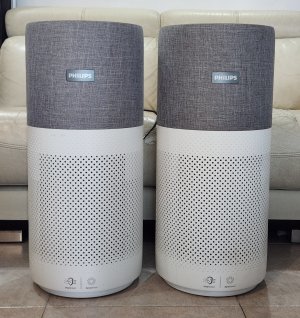
Philips AC3033
Since they are relatively cheap, I got two of them, one for the Master room and one for the living room.
The units are somewhat dusty (one of them is pretty dusty), but the filters are very clean. Unfortunately, one of them is using a non-original filter.
Is compatible filter as good as original? Apparently Philips's original FY3430 filter (S$120+ each at retail price) filters down to 0.003 micron — though some people have questioned if this is possible in a consumer product — with an expected 3 years lifespan, but a compatible filter (~S$40) filters to 0.3 micron only and has 1 year lifespan only. The original filters are getting hard to find. I believe they'll be gone once sold out.
I found original FY3140 filter selling for 177 yuan (S$32.41) on TaoBao. It is cheap, but it is not identical to FY3430, despite what Google AI summary says. It filters down to 0.3 micron only, has one year expected lifespan, and from pics, lacks dust mesh and activated carbon layer.
Using deregistered cars
Apparently it has been happening for a long time. They are hard to catch, but LTA has caught more cars over the years — 40 in 2022, 39 in 2023, 75 in 2024 and 245 in 2025!
The growing number either means LTA is better at catching them, or there is a loophole that can be exploited.
Wow, obviously these people do not fear LTA.
I wonder how it works, though. The Achilles heel, as always, is the IU. How do they get a working IU?
Is it from another registered car? But that means that car no longer have an IU? Or are they able to register the IU for a phantom VRN (Vehicle Registration Number), or car plate in plain-speak — due to lack of checking on LTA's side? Surely LTA will not allow multiple IUs per VRN?
The promise of ERP2, same as ERP1
ERP2 will finally do what LTA has always wanted: adaptive traffic congestion control.
One of the goals of ERP 1.0 is to move from cost of car ownership to usage. It does not work, because ERP gantries are too sparse, too costly to build and they take up a lot of space.
LTA says 93% of vehicles have fitted OBU. OBU is now mandatory by 1/1/2027, and ERP2 will take effect then. ERP2 uses virtual gantries, LTA is free to place gantries at any location. The dream of ERP, after 30 years.
The next step is distance-based charging. This is pay-as-you-use, which is fairer. It is no wonder many drivers dislike it. :lol:
The beauty of ERP2 is that it can be dynamic, e.g. peak vs off-peak and even by total distance.
For example, 5 cents/km for first 10k km ($500), then 10 cents/km for the next 10k km ($1k), 15 cents/km for the next 10k km ($1.5k) and 20 cents/km after ($2k per 10k km). This is fairer than a flat petrol tax. The more you use, the more you pay.
Taxi is charged in reverse: 20 cents/km for first 10k, 15 cents/km for next 10k, 10 cents/km for next 10k and 5 cents/km after. 30k km per year is only 96 km/day (with one rest day per week), which is low for a taxi.
PHV is special. We need to make sure it is not abused. It is charged a flat rate of 30 cents/km, the driver will be reimbursed 20 cents/km based on the distance he is carrying passengers, plus 20% allowance — this information will be provided by the ride-hailing platform. This is to make sure PHV is used for its intended purpose.
| km | Prv | Taxi | PHV | PHV (non-hail) |
|---|---|---|---|---|
| 10k | $0.5k | $2k | $1k | $3k |
| 20k | $1.5k | $3.5k | $2k | $6k |
| 30k | $3k | $4.5k | $3k | $9k |
| 40k | $5k | $5k | $4k | $12k |
| 50k | $7k | $5.5k | $5k | $15k |
| 60k | $9k | $6k | $6k | $18k |
| 70k | $11k | $6.5k | $7k | $21k |
| 80k | $13k | $7k | $8k | $24k |
| 90k | $15k | $7.5k | $9k | $27k |
| 100k | $17k | $8k | $10k | $30k |
Pritam's mistake
Did PS lie? I don't think so, but he could not prove his innocence either. It's a he-said, she-said scenario and obviously his adversaries chose to take the other party's words.
Even before this incident, PS already knew RK was prone to hallucinations, so he wanted to vet her scripts. Her speech was vetted, but she did not correct it.
I don't think PS would tell RK to continue to lie, but he was too lenient on her — no doubt due to her family's clout.
PS is convicted of: (i) telling PK to "take her lie to the grave", (ii) "would not judge her if she maintained her lie".
The "taking to the grave" thing was later revealed to be from her aide — her two aides who gave her irresponsible advice, I must add. It turned out fine for her because PAP could use her to go after a bigger fish.
The second part "would not judge her", I can believe, but only that part, not the part about "maintaining her lie". I feel PS meant he would not judge her for lying, but he left it unsaid that it was time to correct it — too lenient, remember? She just filled in the blanks with what she wanted to believe — hallucinating again.
The G episode
Some people wonder why it is sensational. People have affairs, it is their affair.
Except for three things:
- M portrays himself as a religious person
- G misrepresents herself as a self-made entrepreneur
- From $800 intern to $230k/year (supposedly) VP in 3 years
Life is easy when you have a backer.
Memory price doubled
I've wanted to buy a 32 GB DDR5 memory module since middle of last year, but I kept forgetting / putting it off.
Even in July, there were warnings of RAM shortages.
By the time I remembered — from another article reporting it in Nov — prices were already high.
I bit the bullet and ordered it for S$188 from Amazon. This was the cheapest I found. TaoBao sellers were asking around S$220.
Soon after I bought it, the seller raised his price to S$325. Maybe he priced it wrongly. Luckily he did not cancel the sale.
I just checked. The same RAM from the same seller. It is now S$519. (Maybe it is because Micron is ending Crucial line.)
Will high prices finally force software developers to focus on memory efficiency once more?
Unlikely, everyone is used to 'infinite' memory. Most programs are written with the assumption that the data can fit in memory. This is not wrong, it is just that it does not scale to enormous dataset.
In the past, if you want to deal with enormous data, you have to learn how to 'page' data through memory. It is a technique no one bothers with anymore.
A good example is a text editor in the 16-bit DOS days. If you use the near model, you can only load a ~50 kB text file, which is rather small. To support a big file, you need to use either 'compact' or large memory model. This brings the limit to ~580 kB. This is sufficient for most cases.
But to support really big files, you need a 'paging' technique that pages only part of the file into memory.
The problem is that you cannot scale your program from non-paging to paging trivally. The code is totally different.
Sky Rover Acuity 8x32 bino
I decided to buy the Sky Rover (天虎) Acuity 8x32 ED binoculars from its Blade (刀锋) series. I don't really need it. It is more of a "holy grail" — it is an entry-level 'high-end' bino. :lol:
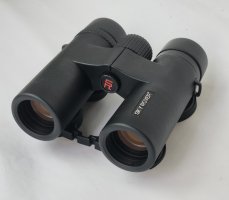
Sky Rover Acuity 8x32
It boasts some impressive specs:
- 8.2° FoV
- Flat field
- 90% light transmission
I got it for its wide FoV and flat-field. I now feel flat-field is essential for wide FoV.
8.5° or so seems to be the 'limit' for 8x32 roof binos. Over that, the bino gets too big/costly and you might as well get a 8x42 — where the high-end is over 9°.
90% light transmission seems low, but I believe it is real, unlike lower-end binos' claim of 92+%. Let's see how it compares against the SV202, my brightest bino so far.
Now that I have four binos, I need to get rid of one:
- Reasur (阅森) Traveler (旅行家) 8x32
- Shengtu (圣途) Forester (森林人) 8x32
- Svbony SV202 8x32 ED (same as Shuntu SHA15 8x32)
- Sky Rover Acuity 8x32 ED
Reasur Traveler 8x32 is a low-end bino I bought for casual use. It is surpisingly decent, despite having no phase coating nor dielectric mirror. I regret not getting the full-white model.
The Forester 8x32 is big and heavy and has nothing special going for it. When I got it, I thought 7.4° was big for 8x32! It turned out not to be the case. Its only saving grace is that it seems to have very honest specs.
The SV202 is supposed to punch above its weight. At first glance, it performs well optically. But more discerning observers have noticed distortion, blurry edges and CA (despite ED glass).
I will decide after comparing how these binos perform optically in terms of sharpness, field curvature (zone of sharpness), vignetting, flare, distortion, CA (Chromatic Abberation) and brightness.
| SR Acuity | Reasur | SV202 | Forester HD 2.0 | Leaysoo | Outland X | |
|---|---|---|---|---|---|---|
| Power | 8x32 | 8x32 | 8x32 ED | 8x32 | 8x32 | 8x42 |
| Prism | BaK4 | BAK4 | BaK-4 | ? | BAK4 | BaK-4 |
| Prism coating | di-electric, phase correction | – | di-electric, phase correction | di-electric, phase correction | – | ? |
| Coating | FMC | FMC | SMC | FMC | FMC | MC |
| L FoV @ 1000 yards | 430 ft | 372 ft | 387 ft | 357 ft | ||
| Angular FoV | 8.2° | 7.08° | 7.37° | 6.8° | ||
| Min focus | 2 m | 2 m | 1.2 m | 4.0 m | ||
| Eye relief | 17 mm | 15.6 mm | 15.6 mm | 17 mm | 16.5 mm | 17.8 mm |
| Eyepiece lens | 23 mm | 18 mm | 21 mm | 21 mm | 19 mm | 21 mm |
| Weight | 495 g | 415 g | 477 g | 555 g | 470 g | 624 g |
| Weight (measured) | 500 g | 460 g | 510 g | 570 g | 410 g | 550 g |
| Size (L x W x H) | 125 x 122 x 41 mm | 125 x 110 x 51 mm | 123 x 115 x 42 mm | 138 x 123 x 48 mm | 135 x 118 x 46 mm | 146 x 126 x 53 mm |
Iran at breaking point
Iran's 6/4 is here.
Who will prevail?
In any case, a regime that fires on its citizens has lost its mandate.
Two crackpot Maduro theories
USA's lightning fast and smooth surgical special operation to capture Maduro alive on Jan 3rd has taken the world by storm.
Prior to this, every pro-China shiller loudly proclaimed USA would not dare to invade Venezuela for two reasons: its strong military defence from its state-of-the-art radar system and missiles, and China's unwavering support.
How did USA manage to execute such a smooth operation? Is it really so advanced technologically?
At that time, I already thought there was more than meets the eye. As days passed, it was revealed that USA had inside help: they had informants providing key intelligence.
But was it just that? The head was gone, but the entire Government appartus remained. They could continue his policies. But it was telling that the military remained silent and everyone was ready to move on.
This made me think USA had achieved a deal with key members of Maduro's Government. Everyone was sick and tired of living in poverty — Venezuela is a resource-rich country!
There was one obstacle: Maduro.
USA came with a deal: they take him, and they'll remove the sanctions on Venezuela. Of course there are other conditions as well (drugs and China), but if Venezuela can have a normal economy, why would it to resort to these?
As the week unfolded, this seems to be a likely theory.
The other theory that I came up with is more outlandish. Maduro allows himself to be captured in return for safe passage. There can be a few reasons why.
One, he is only a figurehead. He wants out, but the powers behind (drug lords?) will not let him go alive.
Two, he believes he is going to be assassinated or ousted. This is not surprising given his unpopularity.
Three, he is actually a 'hostage', a puppet controlled by foreign powers. His core bodyguards were all Cubians. It is said he does not believe in locals. What if they were actually keeping him under close watch?
Then it becomes unsurprising that the Cubian 'bodyguards' all had to die in this operation.
I find it strange that his wife was captured along with him. Normally you just want the man himself. But his wife too? It sounds more like a rescue than kidnapping.
What's in Greenland?
The most obvious is rare earths. But when Arctic ocean thaws and the Northern Sea route opens up, Greenland becomes strategically important.
This is the most likely way for Straits of Malacca to lose its dominance. Many countries have been trying to bypass it for decades, but without success. The countries involved are too poor to afford the project. China can do it, but it faces ownership risk.
On the other hand, the NSR is a natural optimal path from China/Japan to Europe and USA — if not for the ice.
It won't happen soon, but it is hard to say in 20 years time. And once it happens, there is no turning back. Singapore will lose relevance as a port forever.
How serious is USA now? Not very, IMO. It is sounding out other countries and 'staking a claim' — in case other countries (*) are also interested in the future.
(*) Everyone know which country this is.
Even car rental can go bust
Autobahn Rent A Car has 1,700 vehicles and owed over S$300 mil. The cars were from 2022 to 2025.
It was noted some of the cars lack insurance and do not have valid road tax.
It looks like demand was not that strong after all.
1,700 is only a drop in the water. There are 90k Private Hire cars.
Could car rental companies be one of the reasons why COE went up so high? Perhaps, but LTA did not provide any figures.
LTA is pretty pro-PHV in recent years. No doubt it feels a shared car is more 'productive' than a private car.
A PHV loan can be 100% stretched over 10 years. Compare this to 70% (60% if OMV exceeds $20k) over 7 years for normal cars. The downpayment is a barrier.
LTA issued an advisory for car buyers to obtain financing from legitimate, regulated companies. Between 0% and 30% downpayment (which can be $30k to $50k), which do you think they will choose?
Let's see if a few more car rental companies throw in the towel. 2026 is a year where the tide goes out.
Revisiting Talisman 4th ed

Talisman 4th Ed (Black Industries)
Talisman is now into its 5th ed. It has new art and rule changes to speed up the game.
I've sold my Revised 4th ed some years ago. I put up the non-Revised ed for sale too. Someone made an offer, but when I took it out to check, I decided to keep it. This is the last modern take on Talisman 2nd ed, and it is beautiful.
Talisman will always mean 2nd ed to me. Talisman is very random and can take four hours or longer. Nowadays, games are 45 to 90 mins. I've always thought how to speed the game up.
The three biggest issues are movement (unable to land on desired space), leveling up (increasing stats) and catastrophic events (resetting progress). Let's fix a few other issues at the same time too.
Movement
If you move to +/- 1 space away from a corner space, if that space does not have an Enemy encounter, you may move to the corner space instead. If you are one space away from a corner space, you may move there instead of making a normal move.
Lives are used as movement modifiers, except for the last life. You start with 8 lives. You may add or subtract from your move. Any number may be used in the outer region. Only one may be used in the middle region. None may be used in the inner region.
One movement modifier may also be used to make a 'super move' of 7 spaces in the outer region. You may not make a super move if you have a mule (or horse-n-cart).
Movement modifiers may not be used to reach Magic Stream, Fountain of Wisdom and Pool of Life.
Leveling up
Enemy strengh is XP. You only need the same XP as your base strength to level up your strength. This rule is very common and it makes leveling up much faster. Leveling up this way applies to strength only.
There are very few ways to gain craft in the base game. If you lose a life to non-combat non-thirst board/card encounter or to a Spirit enemy, roll a die. If you roll above your craft, you gain a craft.
For Marsh (strength) and Maze (craft), if you lose a turn, you gain the stat if you roll above your stat.
Catastrophic Events
Toad. This is the most catastrophic of all. You lose all objects / followers, have 1 strength / craft and move one space for 3 turns. It definitely needs to be nerfed. New rule: you skip all encounters. You drop (not discard) one gold, life, object or follower per turn. Movement modifiers may be used.
Cursed by Hag. You lose all followers except for her and Poltergeist. It is not too bad, except you need to visit the Village to get rid of her. New rule: you retain two followers (excluding this and Poltergeist). You may leave (not discard) her at the other three corner spaces — laying a landmine for other players! If Cursed by Hag is at a corner space, it must be encountered before the board.
Poltergeist. Limited to one space per turn. This is the least harmful. The problem is that it can take many turns to cross a source of water. New rule: movement modifiers may be used. You may drop a gold, object or follower (including Cursed by Hag and excluding itself) to move normally in a turn.
Raiders. All objects and golds are moved to Oasis. This is very damaging. New rule: roll 1D6 for each object, stolen if 1 - 2. Roll 1D6 for golds stolen.
Home ground
When you reach your starting space, you may choose between: two golds, one life, or gain a stat by trading in 3 cards (objects / followers) — the last one is a common house rule.
(You are at your starting space at the start of the game, so you may choose a benefit right away. Bonus: you may choose a stat without trade-in.)
The starting space then moves to a random space opposite the board (use a marker to mark it). When you reach it, it goes back to your original starting space.
Craft
Craft is not that useful in the base game. Let's make it intelligence and charm as well. You may only have as many spells and followers (in total) as your non-combat non-transient craft. High strength characters have starting advantage. This will incentivize them to increase their craft.
If craft drops, existing spells and followers remain, but new ones may not be acquired.
Gold
You start the game with 3 golds.
Objects
You may carry objects up to your non-combat non-transient strength. It makes sense that stronger characters are able to carry more. One one-handed weapon and armour are excluded from this count. Objects that can move on their own, such as Mule, are excluded as well.
If strength drops, existing objects remain, but new ones may not be acquired.
Enemy encounters
You may skip a non-spirit enemy board/card encounter by dropping a gold.
The Adventure
Rod of Ruin. Cause targeted player to lose two stats. New rule: a player may only lose one stat.
Expansion Set
Whirlwind. 67% chance of losing objects. Reduce to 33%. 1 = blow to 1D6 space away, alternate clock and anti-clockwise. 2 = discard, 3 - 6 = safe