Finally, I got a MT7612 WiFi USB adapter and it worked as expected!
(Not without some panic. I first inserted it in a USB 3.0 port and it was not detected. I thought it was spoilt.)
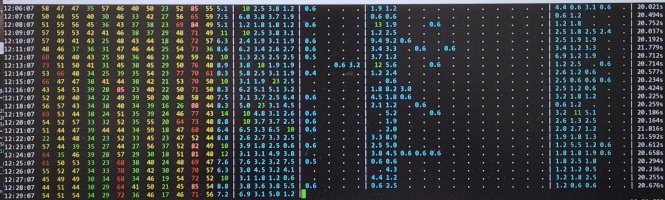
A view of 13 channels in 2.4 GHz, the first four non-DFS 5 GHz channels, the two DFS bands and then the high non-DFS channels. The numbers are utilization in percent. Dot means 0%.
Channel 11 is perpetually utilized. Is it non-WiFi interference? I can't tell because MT7612 has only two out of four metrics: active time and busy time. It does not have receive time and noise.
The sample output from Gemini has them, even when I asked for MT7612 explicitly. Upon further probing, it says it is for MT7615 — an AP-class chip. This is a good example where AI just mashes answers from similar sources to form a 'fuller' answer. It is amazing when it works, but it can fail spectacularly for specs.
Busy time is the bare minimum. It tells you how often the channel is busy. Receive time tells you how much of busy time is valid tranmission, i.e. not due to interference.
One thing that surprises me is that interference from neighbouring channels in 2.4 GHz band do not show up. If channel 6 is busy, I had expected +/- 2 channels to be busy as well. They aren't.
I see two patterns. One, a channel is busy and adjacent channels are clear. Two, immediate adjacent channels of a busy channel are also somewhat busy.
(I can see why routers choose 'random' channels now.)
Gemini says WiFi chips typically use -82 dBm for co-channel interference (Signal Detection threshold), but -62 dBm for noise (Energy Detection threshold). In other words, the +/- 2 channels are weaker than -62 dBm.
I'm not sure this explains what I see.
It takes 40s to scan all 38 channels, even though dwell time is just 100 ms per channel. This is already using 'optimized' scanning, where I take snapshot of several channels at once instead of one-by-one, i.e.
sudo iw dev "$DEV" survey dump >"$tmpf"

for chn in $ar; do
  sudo iw dev "$DEV" set channel "$chn"
  sleep "$DWELL_S"
done

sudo iw dev "$DEV" survey dump >"$tmpf2"
I ran into an unexplained case (bug?) where channel 1 stats were reset when I switched to another channel, so I had to scan it separately.
Much of the overhead is from scripting. On a faster machine, a cycle takes 18s. I increase the dwell time to 300 ms and it takes 26s.
First impression is that the fan head looks smaller than the KDK M40KS. Indeed, the blade measures 35 cm, not 40 cm. I looked it up. Philips use 'head size' as opposed to 'blade size'. Deceptive marketing. Reminds me of CRT monitor sizes.
It is not as silent as it claims. Speed 1 is rather loud due to vibration. The fan is quiet, but the motor housing vibrates rather loudly — resonance? Ironically, speed 2 sounds softer. The motor vibration is gone and it is all fan noise. Sleep mode is exactly the same as speed 1. No change in speed nor noise.
Speed 1 is almost useless. It produces too little wind. You normally place a stand fan in a corner of a room to blow across the room. Speed 2 is good.
Power usage: speed 1 (30W), speed 2 (40W), speed 3 (48W). It uses DC motor supposedly, but it does not seem to be super efficient.
The app control is super laggy. A command takes several seconds to take effect. I didn't feel it previously cos I only controlled air purifiers, and I seldom change the settings.
One of my fans spoilt and I have been looking on-and-off for a replacement, but have not found anything I like. In the mean time, I either suffer from the heat or I turn on the air-con.
I decided to look again, this time with lowered requirements.
I found one very quickly: NNIO 16" stand fan for just S$72!
Good: 16", DC motor, white color. Bad: wide base. Rated 33W with 2,157 CFM. Max 63 dB(A).
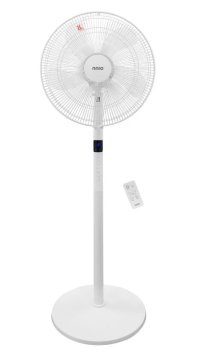
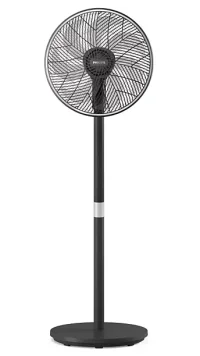
I almost got it, but searching a bit more, I found a Philips 16" model that can be controlled through app, which is a plus. I intend to put it at a "remote" corner. Being able to turn it on and off using my handphone is a huge convenience.
It costs S$85. Too bad it comes in black only. Rated 48W with 1,508 CFM. 19 to 46 dB(A). It is much weaker than N1650.
I checked the spec for my existing 16" KDK M40KS fan. It is 59W with 3,249 CFM. It should be around 2,215 CFM at low speed (987 vs 1,316 RPM). Its lowest speed has more wind than the above two fans at their highest speed.
Aesthetic or wind? :lol:
I got a new WiFi USB adapter based on Mediatek 7921AU. Not only does 'survey dump' not work, but the card also hangs super easily.
I was running U22.04 with HWE kernel 6.8.
Gemini seems to imply the driver is more stable on U24.04, so I upgraded
to it. The upgrade hung midway — it seemed to be waiting for user
input — but luckily it could continue by running dpkg
--configure -a.
(I thought of upgrading to U26.04, since it is already out, but it uses Wayland, I don't know if I can VNC into the PC. I'm running it headless, so it is important.)
It didn't work. It is the same 6.8 kernel, just a few revisions newer. Gemini then again imply it'll work on HWE kernel 7.0, so I upgraded to it. It still didn't work.
Finally, Gemini said 'survey dump' does not work on mt7921. Technically, it did not lie. Upon further questioning, it said mt7921 supports 'survey dump', but the values are zero due to missing hardware support. :duh:
When I first asked which chipset supports 'survey dump', Gemini recommended Mediatek 7612. I got a USB adapter based on it, but the seller sent me a card based on rtl88x2 — same as my existing card. I returned it.
I was going to get another Mediatek card, but I thought why not look for an updated chip with AX support? Gemini said mt7921 supports 'survey dump'. I also thought mt7921 was a superset of mt7612.
The hang issue should be due to my motherboard. It cannot supply enough power — even for USB 3.0 ports. I tried the card on another computer and it seems fine.
Third time's the charm?
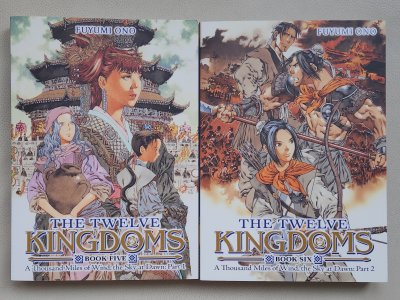
Part 2 is out and I bought it. But that's it, I don't think I'll buy more.
The story, when you read it, is pretty good. But if you give it some thought after that, it has too many coincidences and the relationship web is small and too connected.
It's still a good story. I wish the setting and the characters' thoughts are more fleshed out.
The 3 girls also spent very little time together. This is their individual stories before they met and how they met. I'll love to read more of their adventures where Youko is travelling incognito. Perhaps in a future book, but there's no such book.
